


Project Overview
The client is a precision optical component processing plant, equipped with multiple fully automatic optical visual inspection machines for high-precision imaging inspection of small workpiece dimensions, surface defects, and contours. In the adjacent workshop, cutting and processing equipment is in operation, and external vibrations are continuously transmitted to the optical inspection stations, resulting in blurred imaging, drifting measurement data, and persistently high false rejection rates. Our team conducted on-site ground vibration surveys, and based on the equipment’s self-weight and the sensitive frequency range of the optical imaging, we deployed the LIVA-EP-VC series precision air-spring isolators to complete a full-machine vibration isolation retrofit. Before and after the retrofit, we simultaneously collected imaging data and ground vibration acceleration readings. The isolation performance fully meets the precision requirements for micron-level optical inspection.
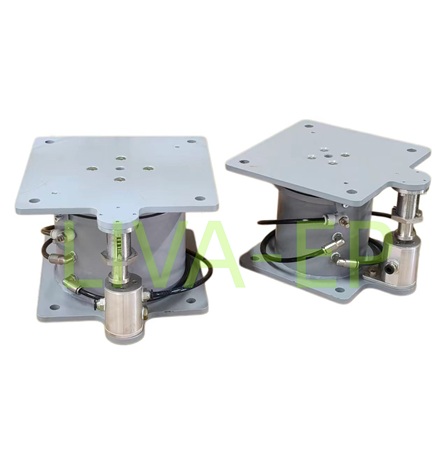
Core On-Site Pain Points Before Retrofit
External Vibration Interfering with Imaging, Causing Failure of Inspection Accuracy
The continuous low-frequency vibration generated by the cutting equipment in the adjacent workshop is transmitted through the floor to the optical inspection platform. The camera images exhibit ghosting and fringe jitter, resulting in poor repeatability of micron-level dimensional measurements. Repeated measurements of the same workpiece show deviations exceeding ±3 μm, leading to a large number of good products being misjudged and scrapped.
Inability to Perform Stable Calibration, Frequent Shutdowns for Adjustment
After each equipment startup, the optical reference coordinates shift. Technicians are required to recalibrate the camera, lighting, and motion platform, severely limiting production capacity.
Accelerated Wear of High-Precision Lenses and Motion Modules
Prolonged micro-vibration causes sticking in the lens focusing mechanism and increased clearance in the linear guide rails. The CMOS sensor of the vision camera is also affected by continuous vibration, shortening its service life, while equipment maintenance costs continue to rise.
Conventional Vibration Isolation Solutions Cannot Meet Precision Optical Requirements
Rubber vibration pads have high natural frequencies and cannot isolate low-frequency ambient vibrations. Ordinary spring isolators lack damping, allowing the machine body to continuously micro-oscillate under small vibrations, failing to meet the passive isolation standards for optical equipment.
Solution: LIVA-EP VC Precision Air-spring Isolator Package
(I) Core Technical Parameters of VC Air-spring Isolators
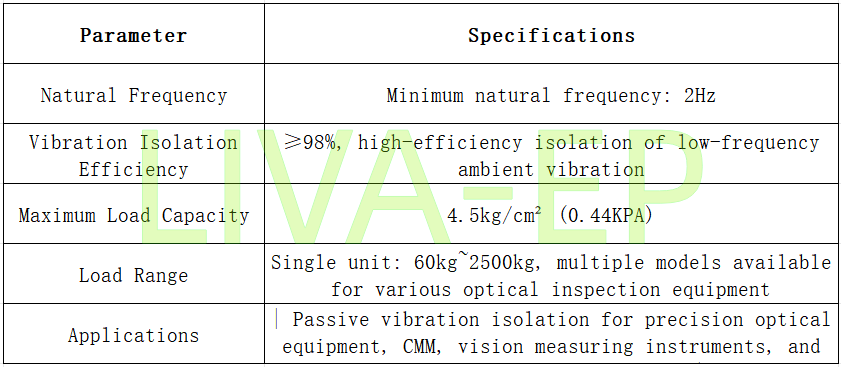
Core Advantages of VC Pneumatic Isolators for Optical Equipment
Ultra-low natural frequency of 2–5 Hz, isolating low-frequency ambient vibration in workshops
Optical equipment is extremely sensitive to low-frequency vibrations in the 7–20 Hz range. The VC series pneumatic isolators feature a natural frequency as low as 2–5 Hz, completely avoiding the excitation frequency bands generated by stamping presses, fans, and assembly lines in the plant, thereby blocking ground vibration from transmitting to the optical table at the source.
High-precision automatic leveling device
The adjacent stamping press in the workshop operates continuously, providing a constant external vibration disturbance. The inspection equipment is equipped with a 5-megapixel high‑precision vision camera, with measurement points arranged simultaneously at two locations: the equipment base and the camera lens mount.
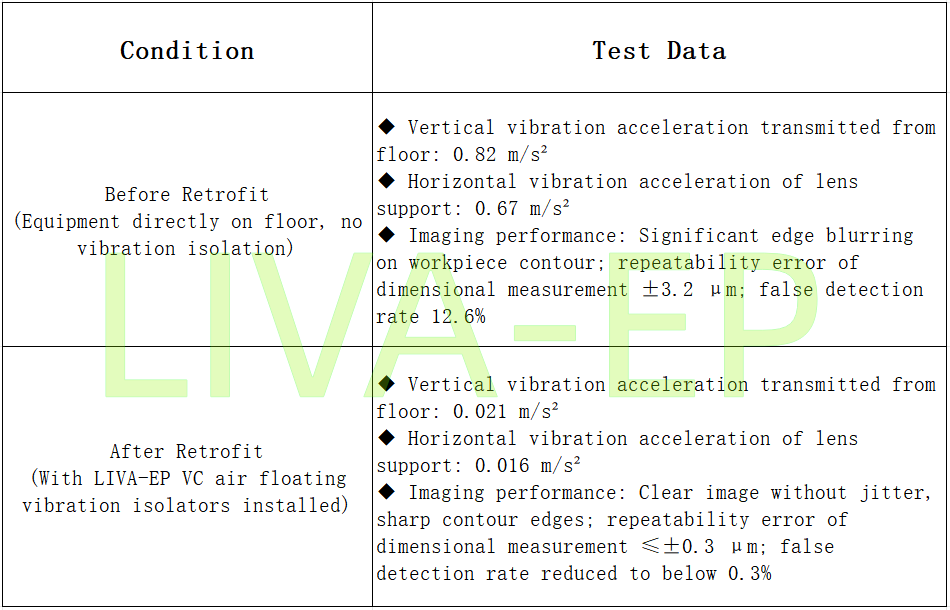
Measured Results Summary
External environmental vibration transmitted to the optical equipment is attenuated by over 97%, completely eliminating low-frequency vibration interference caused by surrounding processing equipment. Imaging stability and inspection repeatability have reached the client's factory acceptance standards.
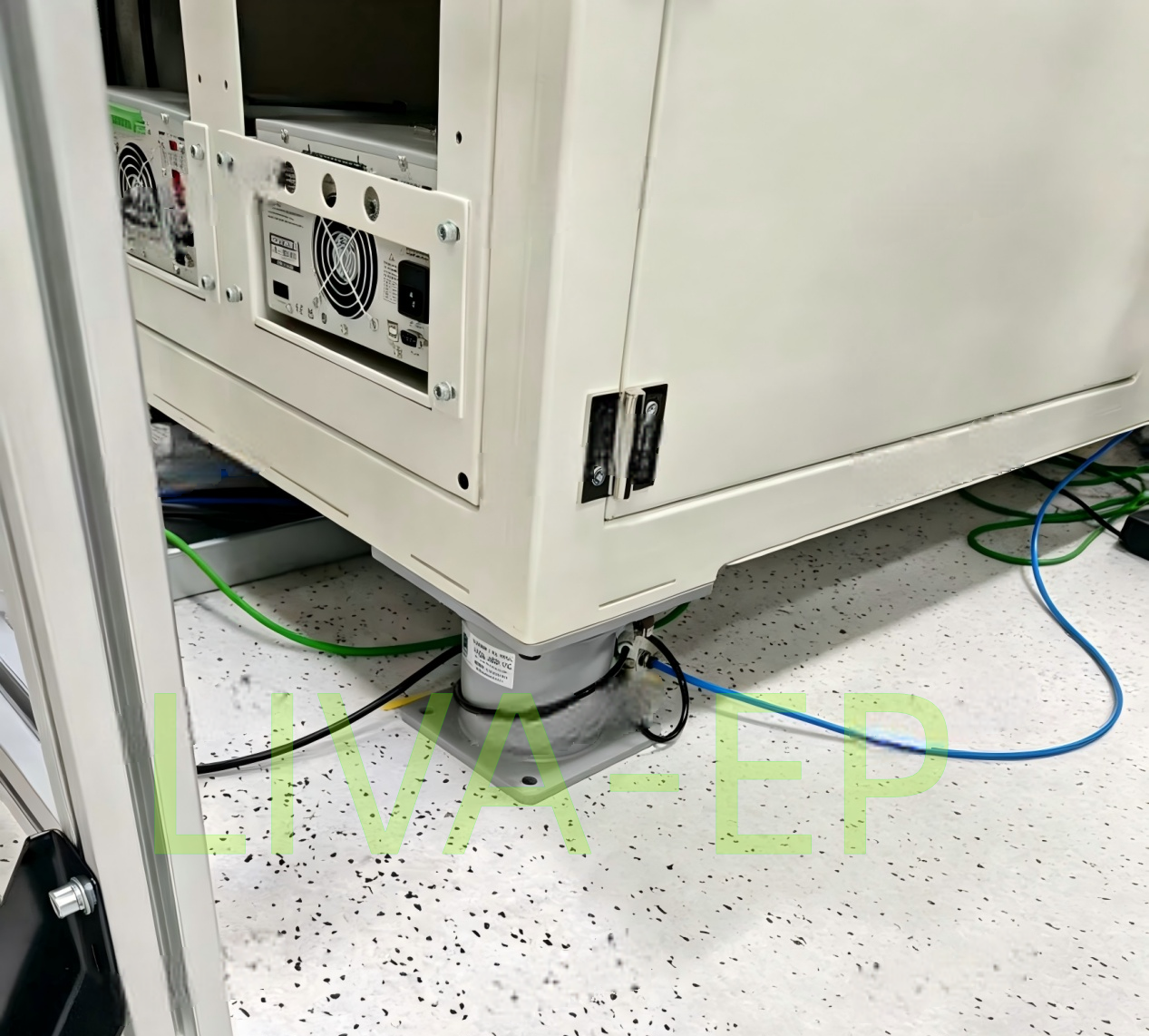
Final Results
Significantly improved inspection accuracy and drastically reduced false rejection rate
Vibration interference is completely eliminated, ensuring stable optical imaging. Repeatability in micron-level dimensional inspection meets specified requirements. The number of workpiece misjudgments and scrapped parts has been reduced by 95%, with substantial savings in raw material costs.
Vibration no longer restricts equipment layout, optimizing workshop space
Liva Environmental Technology (Shanghai) Co., Ltd. (LIVA‑EP) specializes in the R&D and manufacturing of industrial vibration isolation and damping products, with a product line covering pneumatic isolators, spring isolators, wire rope isolators, and more. The company is equipped with a professional vibration testing laboratory and can provide one‑stop vibration control solutions including on‑site vibration surveys, isolation system design, installation and commissioning, and after‑sales maintenance for clients across various industries such as optics, precision measurement, injection molding, stamping, and onboard equipment. Its products are widely used in precision manufacturing, semiconductors, new energy, aerospace inspection, and other fields.


